
Contents
Meta Description
AI powered blogging automation explained in depth. Learn how to scale content creation, SEO, and publishing using AI-driven systems.
Excerpt
AI powered blogging automation is transforming how modern bloggers scale content, rankings, and revenue. This in-depth guide explains systems, workflows, and strategy.
Introduction: Why AI Powered Blogging Automation Is No Longer Optional
Blogging has changed more in the last three years than it did in the previous fifteen. What once required a full editorial team—researchers, writers, editors, SEO specialists, and publishers—can now be orchestrated through intelligent systems driven by artificial intelligence.
AI powered blogging automation is not about replacing creativity. It is about eliminating inefficiency.
Bloggers who still rely on manual workflows are discovering an uncomfortable reality: they are slower, less consistent, and more vulnerable to algorithm shifts than competitors who have automated their content operations intelligently.
In this guide, you’ll learn how AI powered blogging automation actually works, how elite publishers structure their systems, and why automation is the only sustainable way to publish at scale without sacrificing quality or search performance.
This is of a multi-part series. Here, we focus on foundations, architecture, and strategic mindset—before touching content generation, SEO automation, and publishing workflows in later parts.
What Is AI Powered Blogging Automation?
AI powered blogging automation is the systematic use of artificial intelligence tools and workflows to manage, execute, and scale blogging tasks with minimal manual intervention.
This includes:
Topic research and keyword discovery
Content outlining and drafting
SEO optimization and metadata creation
Image generation and alt-text writing
Internal linking suggestions
Publishing and scheduling
Performance monitoring and content updates
The key distinction: automation is not random AI usage. It is a structured, repeatable system that produces predictable, high-quality results.
Most bloggers fail here because they treat AI like a writing shortcut rather than an operational upgrade.
The Shift From Manual Blogging to Automated Content Systems
Traditional blogging workflows look like this:
Manually brainstorm ideas
Use keyword tools sporadically
Write content from scratch
Optimize SEO after the fact
Publish inconsistently
Hope rankings improve
This approach collapses at scale.
By contrast, AI powered blogging automation uses predefined logic and AI-assisted decision-making to move content from ideation to publication in a predictable, scalable manner.
Instead of asking:
“What should I write today?”
You ask:
“What does my system output today?”
That mindset shift is what separates hobby bloggers from media operators.
Why Bloggers Are Adopting AI Powered Blogging Automation at Scale
1. Content Velocity Without Burnout
Publishing frequency is one of the strongest competitive advantages in SEO—when quality is maintained.
AI powered blogging automation allows:
Consistent weekly or daily publishing
Multi-site content scaling
Faster response to trending topics
Reduced creative fatigue
Automation doesn’t remove your voice—it removes repetitive labor.
2. Algorithm Resilience Through Content Depth
Search engines now reward:
Topical authority
Semantic coverage
Content clusters
Manually maintaining this structure is nearly impossible.
AI powered blogging automation excels at mapping topic relationships, identifying content gaps, and ensuring coverage across entire keyword ecosystems.
3. Cost Efficiency for Solo Bloggers and Small Teams
Hiring writers, editors, and SEO specialists is expensive.
AI powered blogging automation allows solo creators to operate like a newsroom—without newsroom overhead.
Core Components of AI Powered Blogging Automation (Strategic Overview)
Before tools or prompts, automation begins with architecture.
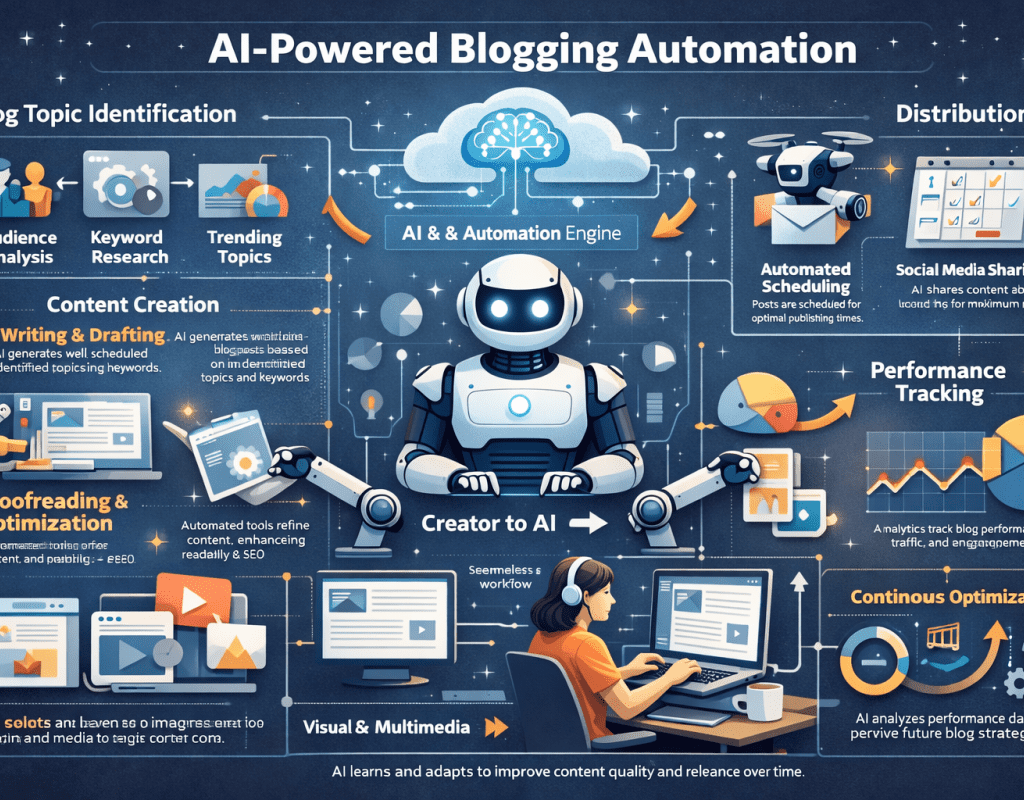
The Five Pillars of Automation
Data Input – keywords, competitors, SERP patterns
Decision Logic – prioritization rules and publishing criteria
AI Execution – content generation and optimization
Human Oversight – editorial review and brand alignment
Feedback Loop – analytics-driven improvement
Without these pillars, automation becomes chaos.
Pillar 1: Data-Driven Topic Intelligence
Automation starts with inputs, not outputs.
Successful AI powered blogging automation systems rely on:
Keyword intent classification
SERP analysis
Content gap identification
Search trend monitoring
AI excels here by processing large datasets faster than humans.
Instead of guessing topics, you feed AI structured keyword sets and competitive data—then let it recommend priority content paths.
Pillar 2: AI-Assisted Decision Logic
Automation requires rules.
Examples:
Publish informational content first for new sites
Prioritize low-competition keywords under DR 30
Expand clusters only after pillar pages rank
Update content every 90 days
These rules guide AI behavior.
Without them, AI produces content—but not strategy.
Pillar 3: Content Creation Engines
This is where most bloggers focus—and where most fail.
AI powered blogging automation is not “write a 2,000-word article.”
It is:
Structured outlines based on SERP analysis
Section-by-section drafting
Semantic keyword integration
Tone and brand calibration
Tools like **OpenAI models accessed through platforms such as ChatGPT are powerful—but only when constrained by structure.
Pillar 4: Human Editorial Control
Automation does not eliminate humans—it elevates them.
Human responsibilities include:
Final editorial review
Brand voice enforcement
Fact-checking
Strategic content direction
The most successful AI powered blogging automation workflows maintain human approval checkpoints, especially for money pages and brand-critical content.
Pillar 5: Feedback and Continuous Optimization
Publishing is not the end.
AI powered blogging automation systems track:
Rankings
Click-through rates
Engagement metrics
Conversion performance
AI can then recommend:
Content expansions
Section rewrites
Internal link adjustments
Metadata updates
This creates a self-improving content ecosystem.
AI Powered Blogging Automation vs AI Content Writing (Critical Difference)
Many bloggers confuse these concepts.
| AI Content Writing | AI Powered Blogging Automation |
|---|---|
| Single task | End-to-end system |
| Output-focused | Process-focused |
| Manual prompting | Automated workflows |
| Inconsistent results | Predictable outcomes |
| No scalability | Infinite scalability |
Writing with AI is a feature.
Automation is an operating model.
Common Myths About AI Powered Blogging Automation
Myth 1: Google Penalizes Automated Content
Google penalizes low-quality content, not automation.
If automation produces:
Helpful content
Clear intent match
Original structure
Real value
It performs exceptionally well.
Myth 2: AI Content Sounds Generic
Poor prompts create generic output.
Structured systems with editorial oversight produce content indistinguishable from expert human writing.
Myth 3: Automation Removes Creativity
Automation removes friction—not creativity.
When repetitive tasks disappear, creators focus on strategy, storytelling, and growth.
Foundational Tool Categories (Not Recommendations)
At this stage, think in categories, not brands:
AI language models
SEO research platforms
Workflow automation tools
CMS platforms like WordPress
Analytics and tracking systems
Tools change. Systems endure.
Who Benefits Most From AI Powered Blogging Automation?
Niche site builders
Affiliate marketers
Content agencies
SaaS content teams
Personal brand bloggers
Media startups
If content drives revenue, automation multiplies output.
Strategic Mistakes to Avoid Early
Automating before validating topics
Publishing without editorial review
Ignoring internal linking logic
Over-optimizing keywords
Scaling content without analytics
Automation amplifies mistakes as fast as it amplifies success.
Internal Link Suggestion (For SEO)
Suggested internal article to link from this post:
“Topical Authority SEO: How Content Clusters Dominate Rankings”
Image Placement & Alt-Text Suggestions
Hero Image Alt Text: AI powered blogging automation workflow for scalable content creation
Section Image Alt Text: AI powered blogging automation system for SEO-driven blogging
Dashboard Image Alt Text: AI powered blogging automation tools for modern bloggers
AI Image Prompt Examples
“Futuristic blogging workflow showing AI-powered content creation, SEO analysis, and automated publishing”
“Professional blogger using AI dashboard to manage automated blog content”
“Visual diagram of AI powered blogging automation pipeline”
Why Traditional Keyword Research Fails at Scale
Classic keyword research follows this flawed pattern:
Find a keyword with volume
Write one article
Optimize on-page SEO
Repeat
This model ignores how search engines now evaluate authority.
Google does not rank pages in isolation. It ranks topics, entities, and coverage depth.
That is why AI powered blogging automation focuses on systems of keywords, not individual terms.
The New SEO Reality: Topical Authority Over Single Keywords
Topical authority means your site becomes a trusted source for an entire subject—not just one query.
Search engines evaluate:
Content breadth
Semantic keyword coverage
Internal linking structure
Consistency of publishing
Depth of answers
AI powered blogging automation excels here because it can:
Process thousands of keywords at once
Group them by intent and semantics
Identify missing subtopics
Recommend publishing order
This is impossible to do manually with accuracy.
How AI Powered Blogging Automation Handles Keyword Research Differently
Instead of asking:
“What keyword should I target?”
Automation asks:
“What topic should I own?”
This is a structural shift.
AI powered blogging automation treats keywords as data points, not goals.
Step 1: Keyword Universe Expansion Using AI
The first phase is building a keyword universe.
This includes:
Primary keywords
Secondary keywords
Long-tail variations
Question-based queries
Comparison and transactional terms
AI can expand a single seed keyword into hundreds or thousands of related queries using semantic analysis.
For example, a seed like:
“AI blogging”
Can expand into:
AI blogging tools
AI blogging automation workflows
AI blogging for SEO
AI blogging vs human writing
AI blogging content strategy
This expansion layer is the foundation of AI powered blogging automation.
Step 2: Search Intent Classification at Scale
Not all keywords are equal—even if volume is similar.
AI powered blogging automation categorizes keywords by intent:
Informational
Commercial
Transactional
Navigational
AI can detect intent by analyzing SERP patterns, modifiers, and competitor content types.
This matters because intent determines content format.
Publishing the wrong format—even with perfect SEO—kills rankings.
Step 3: Keyword Difficulty and Opportunity Scoring
Traditional difficulty metrics are static.
AI powered blogging automation uses relative opportunity scoring, which considers:
Domain authority gap
SERP content quality
Content freshness
Search intent saturation
This allows automation to surface low-resistance opportunities that competitors overlook.
Instead of chasing high-volume keywords, the system prioritizes ranking velocity.
Step 4: Semantic Clustering and Topic Mapping
This is where AI powered blogging automation separates amateurs from professionals.
AI groups keywords into semantic clusters based on meaning—not just shared words.
Each cluster includes:
One pillar keyword
Multiple supporting subtopics
Long-tail question queries
This structure mirrors how search engines understand topics.
The Pillar-and-Cluster Model Explained Simply
Every topic has:
Pillar pages – comprehensive, authoritative guides
Cluster pages – focused subtopic articles
AI powered blogging automation identifies:
Which keyword becomes the pillar
Which keywords support it
How they interlink
This creates SEO gravity, pulling rankings upward across the entire cluster.
Publishing Order Matters (And AI Decides It)
Most bloggers publish randomly.
AI powered blogging automation publishes strategically.
Typical automated publishing logic:
Foundational informational clusters first
Supporting subtopics next
Commercial pages after authority builds
Comparison and buyer-intent content last
This mirrors how trust is built algorithmically.
Automating Content Brief Creation
Once clusters are defined, AI powered blogging automation generates content briefs automatically.
Each brief includes:
Target keyword and variations
Search intent
Recommended word count
Heading structure
Questions to answer
Internal linking targets
This removes guesswork for writers—or for AI writing systems themselves.
Why Content Planning Is the Highest-Leverage Automation Layer
Writing is visible. Planning is invisible.
But planning determines:
Ranking potential
Content efficiency
ROI per article
AI powered blogging automation ensures every article serves a structural purpose.
No orphan content. No wasted effort.
Real-World Example: Niche Site Authority Build
Consider a niche like “remote work tools.”
Manual approach:
Random tool reviews
No internal structure
Slow growth
Automated approach:
Pillar: “Remote Work Software Guide”
Clusters:
Time tracking tools
Communication platforms
Project management software
Security tools
AI powered blogging automation builds all clusters methodically—resulting in compound ranking growth.
Integrating AI Keyword Research With CMS Planning
Modern automation workflows connect planning directly to publishing platforms like WordPress.
This allows:
Automated editorial calendars
Status tracking by cluster
Priority scoring inside the CMS
Publishing cadence control
Planning becomes operational—not theoretical.
The Role of Competitive Intelligence in Automation
AI powered blogging automation constantly monitors competitors.
It tracks:
New content published
Keywords gained or lost
Content gaps
SERP volatility
AI then recommends:
New cluster creation
Content expansion
Defensive updates
This turns SEO into a living system.
Why Manual Topical Authority Building Breaks Down
Humans struggle with:
Maintaining consistency
Seeing macro patterns
Updating hundreds of URLs
Tracking semantic gaps
AI powered blogging automation handles these at scale—without fatigue.
Common Mistakes in AI-Driven Keyword Planning
Chasing volume over intent
Building clusters too broad
Ignoring internal linking logic
Publishing commercial pages too early
Not updating keyword maps quarterly
Automation amplifies planning errors—so strategy still matters.
How Often Keyword Maps Should Be Updated
Best practice with AI powered blogging automation:
Light refresh every 30 days
Full cluster audit every 90 days
Competitive re-analysis every 6 months
Search landscapes shift. Automation adapts.
Internal Linking Strategy Starts at Planning Stage
Internal links are not added randomly.
AI powered blogging automation pre-defines:
Parent-child relationships
Link anchors
Link flow direction
This strengthens clusters before content is even written.
From Keyword Maps to Content Calendars
Once planning is complete, AI powered blogging automation generates:
Monthly publishing schedules
Cluster completion timelines
Content velocity targets
This removes emotional decision-making from publishing.
Why This Planning Layer Is Where Most Sites Lose
Many bloggers jump straight to AI writing.
They skip planning.
As a result:
Content cannibalizes itself
Authority fragments
Rankings stall
AI powered blogging automation solves this by enforcing structure first, content second.
Tool Categories Used in This Phase (Conceptual)
Again, think categories—not brands:
Keyword data providers
SERP analysis engines
Semantic clustering systems
Workflow automation tools
CMS integrations
Some workflows may involve AI models from OpenAI, but tools are interchangeable. Strategy is not.
Internal Link Suggestion (For SEO)
Suggested internal article to link from this post:
“AI Content Clusters: How to Build Topical Authority Faster”
Image Placement & Alt-Text Suggestions
Hero Image Alt Text: AI powered blogging automation for keyword research and topical authority
Cluster Diagram Alt Text: AI powered blogging automation content cluster strategy
Planning Dashboard Alt Text: AI powered blogging automation SEO planning system
AI Image Prompt Examples
“AI analyzing thousands of SEO keywords and grouping them into content clusters”
“Topical authority SEO diagram with AI-powered planning system”
“Digital marketer using AI dashboard to plan blog content at scale”
Conclusion:
AI powered blogging automation is not a shortcut. It is an operating system for modern publishing.
What automation truly means
Why it outperforms manual workflows
The five pillars that support scalable systems
AI powered blogging automation does not win because it writes faster.
It wins because it plans better than humans ever could.
When keyword research, intent mapping, and topical authority are automated intelligently, every article compounds the last.
Keywords become systems
Topics become assets
Planning becomes predictive
If you want rankings that grow instead of fluctuate, AI powered blogging automation must begin at the planning layer.